
AI Hacking Agents Weren't Attacking Us. They Were Using Our Data

TL;DR
- We checked whether AI hacking agents were attacking us. They weren't, but we found something far more interesting: they were using our data to map other organisations, the step that comes before an attack.
- Between 2 and 17 November 2026, 832 servers running agentic offensive frameworks such as ARTEX and CyberStrikeAI mapped 39,460 targets.
- Finance is where they look hardest: payments, banking, crypto and trading make up 17% of the mapped targets, about four times their share among other clients' lookups (4%).
- Each agent host tends to stick to one country (a typical one spends 75% of its country-coded targets on a single country, against 25% for other clients), and a few hosts do most of the work: the busiest 10% made two thirds of all lookups.
- Agents give themselves away by their rhythm, not their speed. Re-running the same domain within a minute plus long pauses mid-session flags about 57% of agent hosts and 6% of ordinary users, and the same fingerprint led us to 11 servers with consoles no public list knew about.
In November we went looking for AI hacking agents in our own traffic. We expected to catch them attacking us.
It seemed a fair guess. ARTEX, CyberStrikeAI and PentAGI are what Google Threat Intelligence Group calls agentic offensive frameworks: they run an intrusion step by step on their own, with a language model that plans, calls a tool, reads the output and decides what to do next. We track their web consoles on the open internet (an earlier post shows how), so we know which servers run them, and a service that hunts these tools looked like a natural target for them. So we took every server publicly identified as running one of these consoles and searched our records for it, expecting password guessing on our sign-in page, payloads in our forms and probes of our services.
That is not what we found. None of those servers had signed in, run a scan or used an API key. Instead, almost all of the requests they sent us in the first half of November were lookups in our data about domains that belong to someone else. What little looked hostile was the background noise every server on the internet gets: automated sweeps for exposed configuration files, admin pages and login forms.
We found no sign of the agents attacking us. They were using us. Before an agent goes after an organisation, it maps what that organisation has on the internet, and part of that mapping runs through public internet-intelligence services like ours. Each lookup shows which organisation an agent is studying and which server is doing the studying, often before anything touches the target.
These tools are no longer a lab curiosity. On 13 November 2026 the FBI published a FLASH alert on ARTEX warning that a variety of malicious actors have used it since at least August 2026 to automate intrusions "at machine speed", from reconnaissance through data theft, against organizations in financial services, government, technology, defense, energy, healthcare and other sectors. Some intrusions went from first targeting to privileged access in under three hours. Researchers the FBI cites counted more than 1,600 ARTEX consoles exposed on the internet in early November, and the framework keeps spreading through forks, localized versions, archived copies and a commercial edition, even after its developer took the original repository offline in October.
Between 2 and 17 November 2026, 832 servers publicly identified as running agentic offensive frameworks mapped 39,460 targets, in 141,953 lookups. Between 184 and 249 of them were busy on any given day.
A rare view of the step before the attack
Most of what is known about AI-driven intrusions comes after the fact: incident reports, leaked consoles, honeypot hits. These lookups show the step before: which organisations an agent is studying, tied to the server doing it. They also show how an agent behaves while it works, which turns out to be as telling as what it looks at.
Who does the mapping
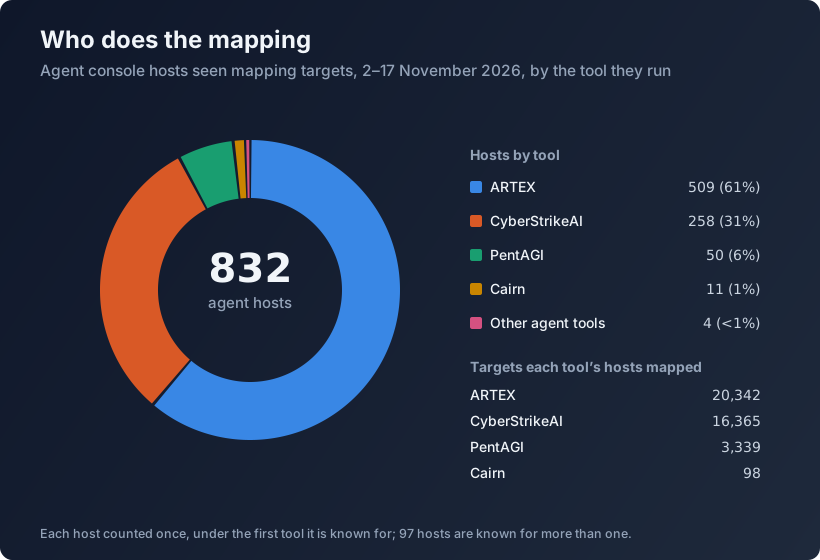
ARTEX hosts did most of the work, with CyberStrikeAI close behind. 97 hosts appear on lists for more than one framework, which fits what we see in the consoles themselves: operators install several tools on one server, and forks and renamed editions of one framework share its code.
Where these servers run says little about who runs them. They sit mostly on cloud and VPS networks in the United States, China, Hong Kong, Singapore and Japan, plus a cluster of offshore hosting registered in the Seychelles.
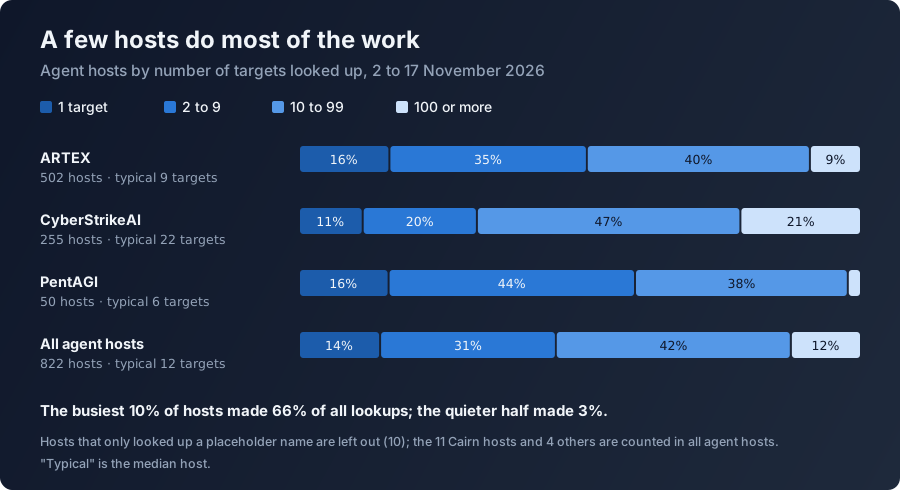
A few hosts do most of the work. A typical host looked up 12 domains over the 16 days, on 3 different days, with about 11 lookups on each. 119 hosts looked up a single domain. At the other end, 100 hosts looked up 100 or more, three of them more than 1,000. The busiest 10% of hosts made two thirds of all lookups (66%); the quieter half made 3%.
CyberStrikeAI hosts work hardest: a typical one looked up 22 domains on 4 days, and one in five reached 100 or more. A typical ARTEX host looked up 9, and one in twelve reached 100. PentAGI hosts are mostly light users, at 6 domains for a typical one, with one exception: the busiest host of all.
The busiest hosts come in two kinds. Some run bulk jobs. Four of the fifteen busiest worked through their lists largely in alphabetical order, the busiest of all 2,698 names over 11 days: small software firms, start-ups and community software projects from all over the world, and even a choir. That looks less like a choice of targets than a list fed to an agent and left to run. Others run long campaigns. One ARTEX host was busy on all 16 days, with 949 domains, nine in ten of those with a country ending Chinese.
Who gets mapped
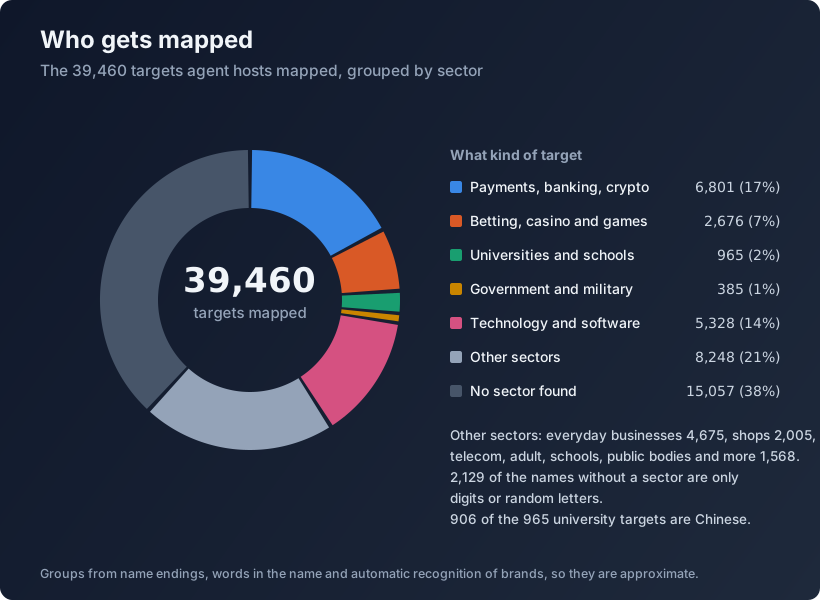
Finance is where they look hardest. 17% of the mapped domains belong to payments, banking, crypto or trading, and 7% to betting, casinos and games. That is three and a half to four times their share among the domains other clients looked up over the same days (4% and 2%). Many are regional: mobile-money and wallet services in Southeast Asia, Central Asia and Africa sit beside global payment processors, banks, brokers and crypto exchanges. That matches the FBI's alert, which lists financial services first among the sectors hit and describes attacks on South Korean financial institutions.
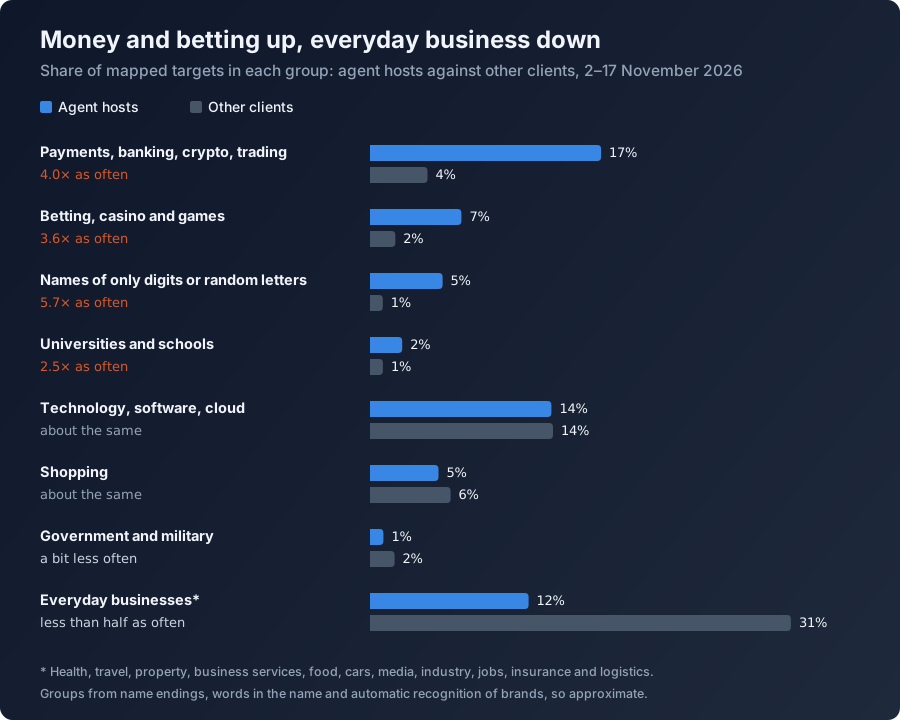
Universities are over-represented too (2% against 1%), and almost all of them are Chinese. Government domains are not: at 1% they turn up less often than in other users' lookups (2%, more than half of that from one client that looked up thousands of government names in two days). The exception is one ARTEX host that walked through 185 entire national government namespaces in a single six-minute sweep.
Everyday business is mapped less, not more. Health, travel, property, business services, food, cars, media, industry, jobs, insurance and logistics together make up 12% of the mapped domains, against 31% of other clients' lookups: less than half as often. Technology companies turn up about as often (14% for both), and shops a little less (5% against 6%). What does stand out is names that say nothing at all: 5% are only digits or random letters that no sector can be read from, against 1% for other clients. For 38% of the mapped domains no sector could be found, so every share here counts only the domains that could be placed.
Most targets are not big brands. 90% of the mapped domains are outside the million most-visited sites, and only about 20 rank in the top 1,000. Agents work the long tail: the smaller company, the regional bank, the forgotten subsidiary. Still, they reach for well-known sites more than other clients do (10% of their domains are among the million most-visited, against 4%), and big companies are on the map: 63 of the 500 companies on the 2026 Fortune 500 list had at least one domain mapped, 14 of them banks, brokers and payment companies.
A few targets are criminal sites themselves. About 1 in 100 of the mapped targets is a site already on public lists of malicious sites: mostly crypto-phishing pages, then servers that spread malware or control infected computers. Among other clients' lookups it is about 1 in 300. So not everyone running these agents is aiming at banks and shops: some aim them at criminal infrastructure, as researchers and threat hunters do.
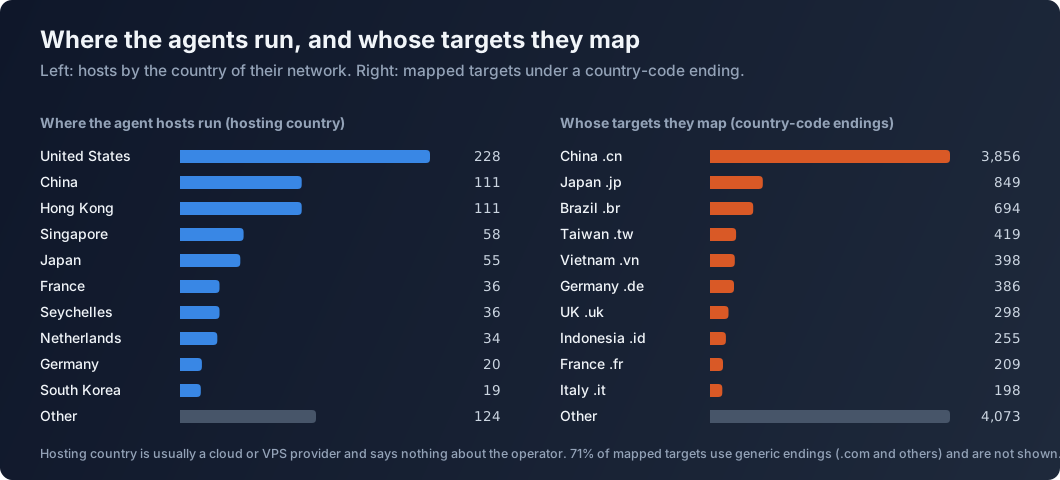
Among domains with a country-code ending, Chinese domains lead by far (3,856), followed by Japan, Brazil, Taiwan and Vietnam. Both crypto platforms and Chinese universities run large public vulnerability-reward programmes, which is a reminder that the same frameworks serve bug-bounty hunters and red teams as well as criminals.
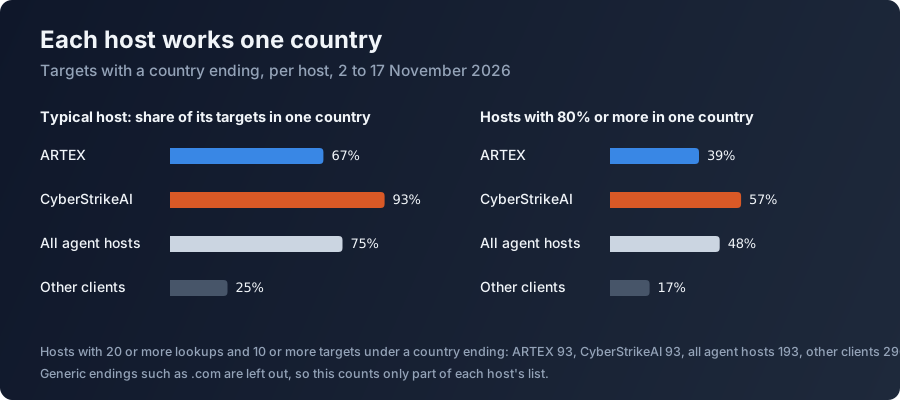
Each host works one country. Agents do not spread their attention. Counting the domains with a country ending, a typical agent host spent 75% of them on a single country, against 25% for other clients, and almost half the agent hosts (48%) spent 80% or more on one country, against 17%. CyberStrikeAI hosts are the most single-minded: a typical one spent 93% on one country, against 67% for ARTEX. For 80 of the 193 agent hosts this counts, that country was China. It is rarely the country the host sits in (one host in five), one more reason not to read much into where a server is hosted.
Each operator works its own list. 92% of the domains were mapped by a single host, and only 126 drew five or more different hosts. Hosts do not share lists either: of the 445 agent hosts with ten or more domains, just one pair shared as much as half of the smaller host's list.
One domain per organisation. For a typical agent host, 10% of its domains share their name with another of its domains (the same company under .com and a country ending, say), against 46% for other clients, who more often map a whole family of one organisation's domains. An agent is usually handed one domain per target.
The rhythm that gives an agent away
A single lookup looks the same whoever makes it. What differs is what happens between lookups. To see it, we compared the agent hosts with a fixed random sample of other clients making the same kind of lookups over the same days, host by host, counting only hosts with at least 20 lookups.
The obvious idea, that agents are simply slower, does not hold up. Counted per host, ordinary users also leave tens of seconds to minutes between domains. Four other signals do separate them:
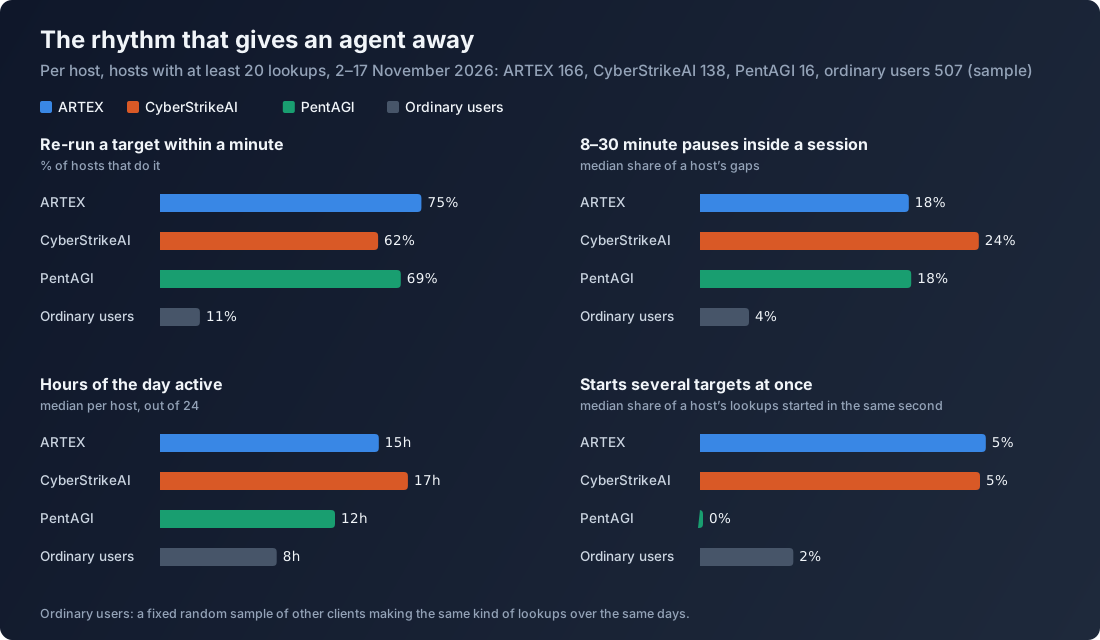
- They ask twice. About two thirds of agent hosts re-run the same domain within a minute; among other clients, about one in nine do. It is not a retry after a failed request (fewer than 1 in 100 of those re-runs follows one), and the gap holds for light and heavy users alike. It looks like an agent repeating a tool call, or two of its sub-tasks asking the same question. The FBI's alert asks victims for exactly this kind of evidence: "multiple sub-agents overwriting each other or generating duplicate requests".
- They pause mid-task. Within a working session, a typical agent host spends 18–24% of its gaps in 8 to 30 minute pauses, against 4% for ordinary users. Between lookups the agent is most likely busy with something else: scanning, reading results, planning.
- They keep going. Over the 16 days, a typical agent host was active in 12–17 different hours of the day; an ordinary user in 8. Almost half of the CyberStrikeAI hosts were seen in 18 or more. They also come back: of the hosts active on two or more days, 70% of agent hosts looked up a domain again on a later day, typically the next day, against 43% of ordinary users.
- Each framework has its own habits. PentAGI hosts almost always look up one domain at a time: 12 of 16 never started two in the same second. ARTEX and CyberStrikeAI hosts do it more often than ordinary users: a typical host of either starts about 5% of its lookups in the same second as another, against 2% for ordinary users. CyberStrikeAI has the slowest rhythm, with a typical host waiting about two minutes between domains, and it works the most hours. ARTEX is the fastest of the three, at under a minute.
No single signal is proof. Together they are a usable fingerprint:
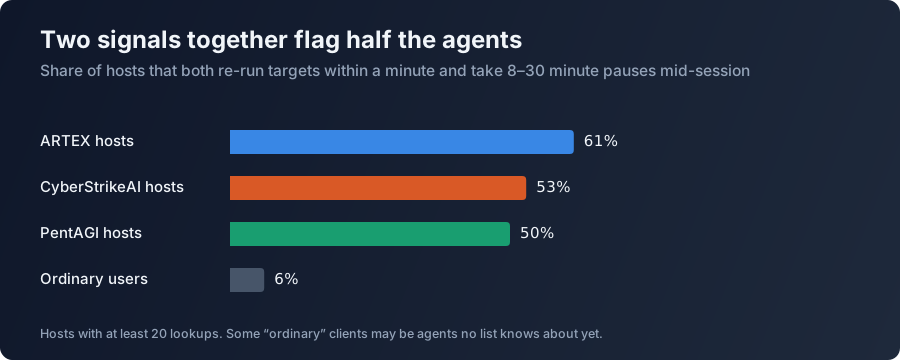
A host that both re-runs domains within a minute and takes long pauses mid-session matches between half and three fifths of each framework's hosts (50–61%), against 6% of ordinary users.
Finding agents nobody has listed
The fingerprint also works the other way round. We applied it to every other client that no list names, kept the hosts on hosting networks that showed all three habits (re-runs, long pauses, activity across most of the day), and looked at what the best-matching 150 of them expose. Five were running the console or panel of an agentic offensive framework that no public list knew about (ARTEX and Xalgorix consoles, a renamed CyberStrikeAI and a password-protected Strix panel), and more were serving other offensive tooling: AI bug-bounty and pentest platforms and a deliberately vulnerable practice app. A comparison group of 54 hosts on the same networks without those habits showed none of this. Run again on 18 November over the week to 17 November, the same search found six more servers with an ARTEX or ExecHawk console that no list knew about.
Most agents keep their console off the open internet, so an empty answer proves nothing. But where the fingerprint can be checked, it points at the right hosts.
Not every agent is an attacker. Most of these frameworks are open source and built for authorized security testing, and penetration testers, red teams, bug-bounty hunters and researchers use them for legitimate work. A console or a lookup shows that someone is using the tool, not whether they have permission.
What this means for defenders
- Assume your internet-facing hosts are on someone's map. If you run a payment, banking, crypto or betting service, the forgotten staging host and the old admin panel are exactly what this reconnaissance is for. Inventory them and take down what you do not need. It is also the FBI's first recommendation: inventory every internet-facing application, including partner and supplier portals, mobile backends, legacy services and third-party integrations.
- The same signals work on your own logs. Duplicate requests within a minute, long pauses inside a working session and activity across most hours of the day are cheap to compute on any API or web log, and they separate agents from people better than request rate does.
- The active fleet changes quickly. Of the agent hosts busy in the second half of these 16 days, 40% had made no lookup in the first half. Watching last week's busy addresses misses much of this week's activity: check against an up-to-date list, and use the behaviour above for hosts no list knows yet.
- A lookup is not an attack. It shows interest, not compromise. Treat it as an early warning, not an incident.
How we counted
We counted lookups of domain intelligence made between 2 and 17 November 2026 by hosts that public threat lists and our own scans identify as running the consoles of agentic offensive frameworks. Each host is counted once, under the first framework it is known for. Sector groups come from the domain ending (government, universities), from words in the name, and, for names those two leave open, from a language model that recognises brands; it placed about four in ten of them. They are approximate: in hand checks of random samples, between 7 and 9 of every 10 word-matched names and about 19 of every 20 model labels were right. Other clients' lookups went through the same steps, the model on a random sample of 5,000 domains. Fortune 500 companies were matched by company and brand names and checked by hand. Country focus counts, for each host with at least 20 lookups and at least 10 domains under a country ending, the share in its most common ending; domains that "share a name" have the same name under different endings; a threat-feed match means the domain, or a name under it, is listed on a public malware, phishing or command-server feed. Times are measured to the second, a session ends after 30 minutes of silence, and the comparison group is a fixed random sample of other clients making the same kind of lookups, compared only in aggregate.
We publish no IP addresses and name none of the domains that were looked up. Hosting addresses change hands, so a few hosts may belong to someone else by now.
Follow the hunts. Each framework in this post has a public hunt that checks every new scan for its console: ARTEX, CyberStrikeAI, PentAGI, Cairn, Strix, Xalgorix and ExecHawk. Follow one to get an email when it sights a new console. Our earlier post explains how they recognise a console, even a renamed one.